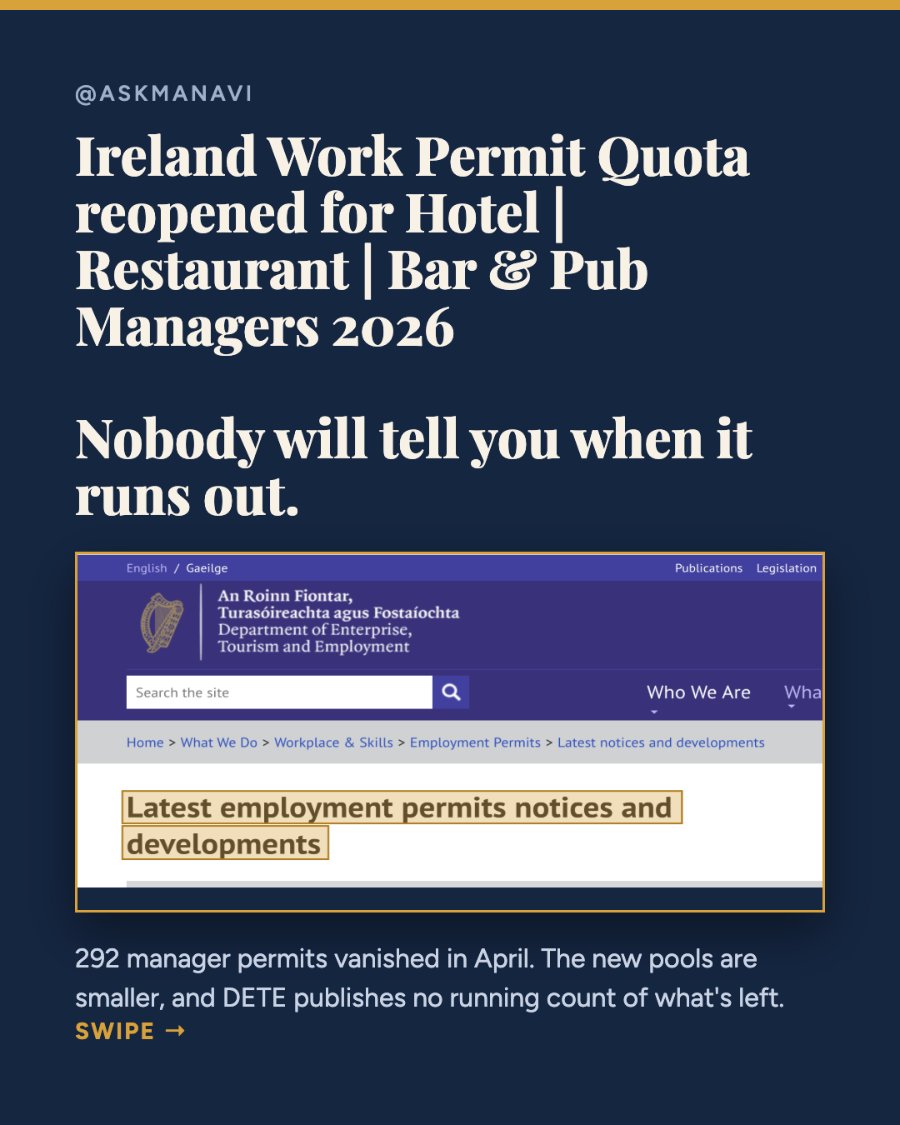
Most people focus on the headline salary figures, but the more important story for anyone planning a career move to Ireland is how those rules are now set. Two mechanisms shape almost every employment permit decision: the occupations lists and the indexation of salary thresholds. Understanding both helps you read where the system is heading, not just where it is today.
The two lists that decide eligibility
Every permit application is measured against two lists maintained by the Department of Enterprise, Tourism and Employment (DETE):
- The Critical Skills Occupations List identifies high-demand roles, often in ICT, engineering, healthcare and finance, that qualify for the fast-tracked Critical Skills Employment Permit and its more generous conditions.
- The Ineligible List of Occupations names roles that generally cannot be filled through a General Employment Permit because there is no recognised shortage.
If a role is on neither list, it is usually eligible for a General Employment Permit, subject to salary and, in many cases, a Labour Market Needs Test. This is why the very first question we ask about any role is: which list, if any, does it sit on?
A rolling, evidence-based review
These lists are not fixed. DETE runs periodic reviews, informed by public consultation and labour-market evidence, to add roles where shortages have emerged and remove roles where the domestic labour supply has caught up. The most recent review drew more than 150 submissions, which tells you how seriously employers and representative bodies engage with the process.
For applicants, the takeaway is that eligibility can change between one application and the next. A role that is ineligible today may open up after a review, and, less happily, a role can move the other way. We keep a close eye on consultation announcements so clients are not caught out.
Thresholds now move with earnings
The second big shift is indexation. Rather than setting salary thresholds and leaving them frozen for years, DETE is increasingly linking the Minimum Annual Remuneration to average earnings using CSO data. Over the last five years, average annual earnings have grown by roughly 4.9%, and that kind of figure now guides how thresholds drift upward.
The 2030 roadmap published in December 2025 formalised this thinking, spreading increases gradually rather than in sudden jumps and committing to phase out the very low sub-standard thresholds in healthcare and agri-food by 2030. Indexation makes the system more predictable, which is genuinely helpful for planning, but it also means the numbers rarely stand still.
What this means for your plans
Because both the lists and the thresholds evolve, we encourage clients to think in terms of a moving target rather than a fixed rulebook:
- Check the current lists before you commit. Eligibility is decided on the rules in force at the date of application.
- Assume modest annual salary rises. Build a small uplift into multi-year plans so renewals clear the threshold in force at renewal time.
- Engage with consultations if you can. Employers and industry bodies genuinely influence which roles make the lists; silence is a missed opportunity.
- Time applications thoughtfully. If a review is expected to add your role, or your salary is close to a rising threshold, timing can matter.
Our take
We see this shift as a maturing of the system. Ireland is moving away from ad-hoc, occasional adjustments towards a framework that is more transparent and more data-driven. That is good news for planning, because predictable rules are easier to work with than sudden ones. But it also means it qualified last year is no longer a safe assumption. Before any application, we confirm the current list position and the current threshold, so there are no surprises. If you are weighing whether a particular role is a realistic route to Ireland, that check is the sensible first step.